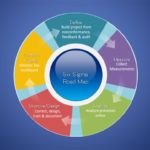

Despite its popularity, Lean Six Sigma often fails to deliver.
As a methodology for improving both output and quality, Lean Six Sigma (LSS) has gained widespread popularity. The approach,which aims to help companies create leaner manufacturing operations and boost product quality to no more than 3.4 defects per million opportunities, has delivered significant improvements and cost savings at companies as diverse as General Electric Co., Dell Inc.,Xerox Corp., and Johnson & Johnson.
But for every Lean Six Sigma success story there are tales of dissatisfaction. Many organizations have trained and deployed legions of Lean Six Sigma Experts, known as black belts, only to see little value result from their efforts.
Five major reasons for Lean Six Sigma failures
There’s a lack of accountability for aggregate results, with teams working independently.
Efforts aren’t tied to corporate goals, and sponsorship is diffused.
The company loses sight of the goal in the heat of training an army of black belts.
The problem returns after a couple of years.
Lean Six Sigma efforts are wasted on areas that will not make a difference.
While Lean Six Sigma can be excellent at remedying obvious maladies like factory bottlenecks, it is less adept at uncovering the hidden sources of pain and identifying and sizing the largest opportunities for cost savings, waste reduction,or revenue generation. It’s wasteful and unnecessary to run every process through Lean Six Sigma; knowing where to focus before unleashing the black belts can make all the difference.
The companies that are yielding the biggest gains from Lean Six Sigma are deploying an upfront diagnostic X-ray to help them identify the most critical opportunities. The key methodology to focus are,
1. Enterprise Value Stream Mapping, in which the project team scans the enterprise and maps its primary processes to identify the biggest opportunities to reduce cost by reducing wasted time and materials.
2. Benchmarking, in which the performance of processes is measured against internal and external benchmarks to measure shortcomings and establish performance-improvement targets.
3. Prioritizing, in which the project team determines which process improvements will yield the greatest results when the Lean Six Sigma teams are deployed.